Appliance Running Cost Calculator
Type in your own cents per kilowatt-hour and find out what each appliance actually costs you — per use, per week and per year. The surprises are usually the slow cooker and the coffee machine you leave switched on.
Australian unitsFree, no sign-upReviewed 10 September 2026
Thermostatically controlled, so it cycles rather than drawing 1,500 W the whole time. Costed at about 85 per cent of nameplate, roughly 1,275 W average.
The usage rate on your bill, in cents per kilowatt-hour. It is the only number here that is actually yours.
Or start from a typical state rate
Running cost
18c per use
Air fryer at 1,500 W for 25 minutes uses 0.53 kWh. At 33c per kWh that is 18c a go, 70c a week and $36.47 a year.
Energy
0.53 kWh
per use
Per use
18c
Per week
70c
4 uses
Per year
$36.47
State rates are indicative residential usage rates and move every quarter. Your bill shows the real one, usually as “usage charge” in cents per kWh — use that and this becomes accurate rather than illustrative. Daily supply charges are excluded here because you pay them whether you cook or not.
The same meal, cooked different ways
Wattage on its own tells you almost nothing, because the appliance that draws the least power often runs the longest. The only fair comparison holds the dish constant. All figures at 33c per kWh.
A tray of frozen chips
Air fryer or oven?
- Air fryerNo preheat worth the name, 20 minutes at 200°C.14c
- Fan-forced oven10 minutes preheat plus 25 minutes cooking.28c
A beef stew for four
Slow cooker, oven or pressure cooker?
- Pressure cookerSear, come to pressure, 35 minutes under pressure, natural release.15c
- Slow cookerEight hours on low.40c
- Fan-forced ovenPreheat plus two and a half hours at 160°C.$1.31
One mug of tea
Full kettle or just enough?
- Boil one mug250 ml, about a minute.1.2c
- Boil a full jug1.7 L, and you reboil it later because it went cold.4.2c
A whole roast chicken
Oven or air fryer?
- Air fryerA 1.6 kg bird in a large basket or oven-style fryer.42c
- Fan-forced ovenPreheat plus 80 minutes at 180°C fan-forced.71c
Typical kitchen appliance running costs
| Appliance | Watts | Per use | Energy | Cost | Per year |
|---|---|---|---|---|---|
| Electric kettle | 2,200 W | 3 min | 0.11 kWh | 3.6c | $39.64 |
| Air fryer | 1,500 W | 25 min | 0.53 kWh | 18c | $36.47 |
| Electric oven (fan-forced) | 2,400 W | 60 min | 1.4 kWh | 48c | $74.13 |
| Portable induction cooktop | 1,800 W | 20 min | 0.48 kWh | 16c | $57.66 |
| Slow cooker (low) | 200 W | 480 min | 1.2 kWh | 40c | $20.59 |
| Multicooker / pressure cooker | 1,000 W | 35 min | 0.32 kWh | 11c | $11.01 |
| Microwave | 1,200 W | 5 min | 0.10 kWh | 3.3c | $17.16 |
| Toaster | 900 W | 3 min | 0.05 kWh | 1.5c | $5.41 |
| Sandwich press | 2,000 W | 6 min | 0.14 kWh | 4.6c | $7.21 |
| Espresso machine | 1,350 W | 6 min | 0.04 kWh | 1.3c | $9.73 |
| Coffee grinder | 150 W | 1 min | 3 Wh | 0.1c | 60c |
| Rice cooker | 700 W | 30 min | 0.21 kWh | 6.9c | $10.81 |
| Bread maker | 600 W | 180 min | 0.72 kWh | 24c | $24.71 |
| Stand mixer | 600 W | 10 min | 0.10 kWh | 3.3c | $3.43 |
| Hand mixer | 300 W | 6 min | 0.03 kWh | 1.0c | 51c |
| Blender | 1,200 W | 2 min | 0.04 kWh | 1.3c | $3.43 |
| Stick blender | 800 W | 2 min | 0.03 kWh | 0.9c | $1.37 |
| Food processor | 900 W | 5 min | 0.07 kWh | 2.5c | $2.57 |
| Juicer | 800 W | 5 min | 0.07 kWh | 2.2c | $3.43 |
| Food dehydrator | 500 W | 600 min | 3.5 kWh | $1.16 | $60.06 |
| Sous vide circulator | 1,000 W | 180 min | 1.0 kWh | 35c | $18.02 |
| Vacuum sealer | 130 W | 2 min | 4 Wh | 0.1c | 15c |
| Milk frother | 500 W | 2 min | 0.02 kWh | 0.6c | $2.00 |
| Popcorn maker | 1,200 W | 3 min | 0.06 kWh | 2.0c | $1.03 |
| Electric pasta maker | 200 W | 15 min | 0.05 kWh | 1.7c | 86c |
| Dishwasher (normal cycle) | 1,200 W | 120 min | 1.2 kWh | 40c | $103 |
What it costs to leave things on
| Left on | Draw | Per year | Worth doing something about? |
|---|---|---|---|
| Espresso machine left switched on | 45 W | $130 | The single most expensive standby load in most Australian kitchens. |
| Microwave clock | 3 W | $8.67 | Trivial per hour, but it never stops. |
| Oven clock and display | 3 W | $8.67 | Same story, and you cannot switch it off. |
| Bench-top appliance on standby | 1.5 W | $4.34 | Air fryers, multicookers and toasters with a display. |
Typical electricity rates by state
| State | Typical usage rate | Boiling a full kettle | A roast chicken in the oven |
|---|---|---|---|
| New South Wales (NSW) | 34c/kWh | 4.4c | 73c |
| Victoria (VIC) | 29c/kWh | 3.7c | 63c |
| Queensland (QLD) | 31c/kWh | 4.0c | 67c |
| South Australia (SA) | 43c/kWh | 5.5c | 93c |
| Western Australia (WA) | 32c/kWh | 4.1c | 69c |
| Tasmania (TAS) | 30c/kWh | 3.9c | 65c |
| Australian Capital Territory (ACT) | 26c/kWh | 3.3c | 56c |
| Northern Territory (NT) | 29c/kWh | 3.7c | 63c |
Wattage is a bad guide to cost
The number on the sticker is the draw at full tilt, and it tempts everyone into the same mistake: assuming the low-wattage appliance is the cheap one. A slow cooker draws about a twelfth of what an oven does and still costs almost as much to cook a stew, because it runs for eight hours instead of two and a half. Cost is watts multiplied by hours, and the second term is the one people forget.
The other half of it is the duty cycle. An oven does not hold 2,400 W for an hour — it pulls full power to reach temperature, then switches the element on and off to stay there, averaging perhaps 60 per cent across the session. A sous vide circulator is more extreme again: full power for ten minutes to bring the bath up, then a trickle to hold it. Anything with a motor, and a kettle, has no thermostat at all and draws its full rating the whole time it is on.
Where the real money is
Almost none of it is in the appliance you were worried about. In a typical Australian kitchen the ranking is consistent:
- The oven, by a wide margin, because it heats a large insulated box for a long time. Using an air fryer or a multicooker for anything that fits in one is the single biggest saving available.
- An espresso machine left switched on. Forty-odd watts sounds trivial until you multiply it by 8,760 hours. It is genuinely possible to spend more on standby than on coffee.
- The kettle, not because each boil is expensive but because there are so many of them. Filling it to the line you need rather than to the top is a real, if small, saving repeated several times a day.
- The dishwasher, where nearly all the energy goes on heating water rather than running the pump. An eco cycle takes longer and costs less, which feels wrong and is true.
- The dehydrator, which nobody expects. Ten hours at 500 W is more energy than a roast dinner.
Reading your own bill
Look for the usage charge, quoted in cents per kilowatt-hour. That is the number to type above. If you are on a time-of-use plan you will have two or three of them — peak, shoulder and off-peak — and cooking dinner almost always lands in peak. If you have solar, the sum that matters is your feed-in tariff rather than your usage rate, because running the dishwasher at noon costs you the few cents you would have been paid for exporting instead.
The daily supply charge is deliberately left out here. It is a fixed fee for being connected, it applies whether you cook or not, and folding it into a per-meal figure would only make every appliance look worse without changing which one to reach for.
The savings that are actually worth having
Match the appliance to the job rather than buying a more efficient version of the wrong one. A slow cooker beats the oven for a long braise; an air fryer beats both for anything under half an hour; the microwave beats everything for reheating. Keep the oven door shut — every look costs about 15°C and the element has to make it back. Use residual heat: switch a fan-forced oven off five or ten minutes early and let the cavity finish the job.
And boil what you need. If you want to be precise about that, the cups and grams converter will tell you how much water a recipe actually calls for, and the slow cooker converter will tell you how long the cheaper appliance needs.
Running costs — Frequently Asked Questions
How do I work out what an appliance costs to run?+
Multiply the wattage by the hours it runs, divide by 1,000 to get kilowatt-hours, then multiply by your electricity rate in cents per kWh. A 1,500 W air fryer for 30 minutes is 0.75 kWh, and at 33c that is about 25 cents. The calculator above does it for you and adds a duty cycle for anything thermostatically controlled.
Is an air fryer cheaper to run than an oven?+
Yes, and by more than most people expect. A tray of chips takes about 0.43 kWh in a 1,500 W air fryer against roughly 0.84 kWh in a fan-forced oven, because the oven draws more power, needs a preheat and heats a far larger cavity. Over a year of twice-weekly chips that is a small but real saving — and the gap widens for anything cooked in under half an hour.
Are slow cookers cheap to run?+
Cheaper than an oven, but not as cheap as the wattage suggests. A slow cooker draws only about 200 W, but it runs for eight hours, so a stew costs roughly 1.2 kWh — not far off what the same stew would take in the oven over two and a half hours. The saving is real; it is just nothing like the ten-to-one the wattage implies.
How much does it cost to boil a kettle in Australia?+
About 3 to 4 cents for a full 1.7 L jug on a 2,200 W kettle at typical Australian rates. Boiling only what you need for one mug costs about a third of that. It is a small number, but Australians boil the kettle several times a day, so the annual figure is larger than the per-use one suggests.
What electricity rate should I use?+
The usage rate on your own bill, in cents per kilowatt-hour. It is usually shown as a "usage charge" or "general usage" and sits somewhere between 25 and 45 cents depending on your state, retailer and plan. The state figures in the calculator are indicative starting points only — they move every quarter.
Does the daily supply charge count?+
No, and the calculator deliberately excludes it. The supply charge is a fixed daily fee you pay whether you cook or not, so including it would make every appliance look more expensive than it is and would not change which appliance to choose.
Do appliances use power when they are switched off?+
Anything with a clock, a display or a standby light does. The worst offender in most Australian kitchens is an espresso machine left switched on, which can draw 40 to 50 W all day — more over a year than the coffee it makes. Microwave and oven clocks are trivial individually but never stop.
Why is the calculated figure lower than the appliance wattage suggests?+
Because anything with a thermostat cycles. An oven pulls its full 2,400 W to get up to temperature and then switches its element on and off to hold it, so across a whole hour it averages closer to 60 per cent of nameplate. The calculator applies a duty cycle for ovens, slow cookers, sous vide circulators, dehydrators and dishwashers. Motors and kettles do not cycle, so they are costed at full power.
More kitchen calculators
Oven Temperature Converter →
Fan-forced to conventional, Fahrenheit to Celsius and gas marks, the way Australian recipes actually write them.
Cups to Grams Converter →
Australian 250 ml cups and 20 ml tablespoons to grams for 60+ ingredients, plus grams back to cups.
Air Fryer Conversion Calculator →
Turn any oven recipe into an air fryer time and temperature in Celsius, with a chart of Aussie freezer staples.
Meat Temperature Guide →
When to take steak, roasts, chicken, pork and fish off the heat, in Celsius, with the Australian food-safety minimums alongside.
Roast Timer →
Cooking time by weight for lamb, beef, pork with crackling, chicken, turkey and glazed ham, plus a serve-time plan that works backwards from lunch.
Slow Cooker Conversion Calculator →
Move a recipe between the oven, the stovetop, a slow cooker and a pressure cooker — including what to do about the liquid.
Cake Tin Converter →
Scale a recipe from the tin it was written for to the tin you own, in centimetres and inches, with the baking time adjusted.
Rice to Water Ratio Calculator →
Water, time and yield for nine kinds of rice by saucepan, rice cooker, pressure cooker or microwave — and the 180 ml cup that ruins it.
Coffee to Water Ratio Calculator →
Grams of coffee to millilitres of water for plunger, pour over, AeroPress, moka, cold brew and espresso, with the grind and the time.
Food Storage Chart →
How long 50 foods last in the fridge, the freezer and a vacuum bag, with the Australian food-safety rules that override every number.
Useful? Send it to whoever does the baking.
The cheapest way to cook most weeknight meals
An air fryer costs about half what a fan-forced oven does for anything that takes under half an hour. These are the seven we rank for Australian kitchens.

#1 Ninja XXXL FlexDrawer Air Fryer 10.4L AF500ANZ
★ 4.8 (266 reviews) · A$353.08

#2 COSORI Dual Blaze 6.4L Air Fryer
★ 4.7 (9,596 reviews) · A$326.24
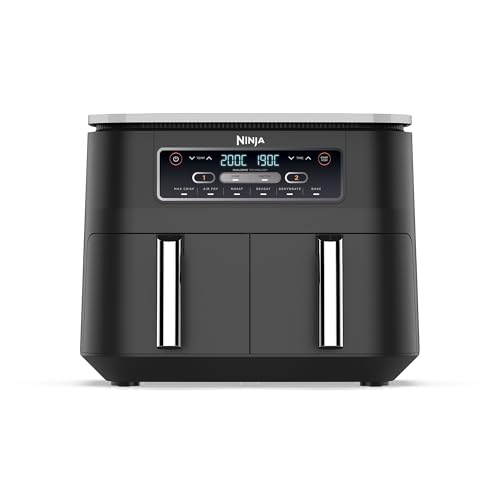
#3 Ninja Foodi Dual Zone Air Fryer 7.6L AF300ANZ
★ 4.7 (15,315 reviews) · A$179
Our rankings
Weekly kitchen deals, in your inbox
We check prices on every appliance we cover daily. Once a week we send the biggest genuine price drops we spot - the ones worth your bench space.
- One email a week, max
- No spam, ever
- Unsubscribe in one click