As an Amazon Associate, top7kitchen.au earns from qualifying purchases. Product prices and availability are accurate as of the date/time indicated and are subject to change. Any price and availability information displayed on amazon.com.au at the time of purchase will apply.
Rankings re-checked weekly · Last re-checked 16 October 2026
·Prices updated daily·AI-assisted, run by Jaco Olwagen
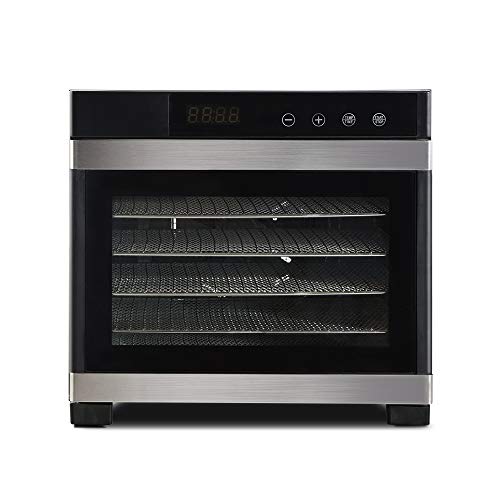
A 1000W stainless-steel cabinet with ten 304 stainless trays, a rear fan for horizontal airflow, a 30 to 90 degree thermostat and a 48-hour timer.
Why it's number one: Top marks for performance, capacity and build: a rear fan with horizontal airflow, 1000 W, a 30 to 90C thermostat, ten 304 stainless trays and a 48-hour timer, with 4.6 stars from 146 Amazon AU ratings. No outlet has reviewed it, and it is the biggest, heaviest and dearest unit here.
If you are serious about jerky, or you regularly need to process a whole tree's worth of fruit, the VEVOR ten-tray cabinet is the most capable dehydrator in this guide. Its rear-mounted fan and 1000W of drying power push warm air horizontally across every shelf, so all ten trays dry evenly without the rotating ritual that stackable units demand. The trays are food-grade 304 stainless steel at a generous 377 by 285 millimetres each, BPA-free and dishwasher-safe, and the corrosion-resistant stainless body has a built-in LED light so you can keep an eye on progress through the door. The digital panel sets the timer anywhere from half an hour to 48 hours and the thermostat from 30 to 90 degrees, which comfortably covers delicate herbs at one end and safe jerky temperatures at the other. VEVOR also throws in silicone roll sheets for fruit leather, sieves, gloves and recipes. It rates 4.6 stars across 141 Amazon reviews and is sold by VEVOR's Australian store. It is a big, heavy machine and a premium spend, but nothing else here matches its combination of capacity, control and even drying.
Performance
9.6
Capacity
10.0
Ease of Use
9.6
Build
9.3
Owners
8.4
Owners is the 4.6★ Amazon AU rating from 162 reviews, weighted toward the category average when there are few. Fewer than two published reviews of this exact model, so the owner rating carries that weight too. Tick marks show the category average.
How we scored it
Each measure is marked against the category's rubric, where 10 is the best you can buy, 8 is strong, 6 is basic but sound and 4 falls short. The bars show that mark on the Top7 scale (a 6 reads as 7.0, an 8 as 8.5); the notes quote the rubric mark.
Performance 9.6 (rubric 9.5): Rule: rear fan with horizontal airflow scores 8, plus 1 for a 30 to 90C thermostat and 0.5 for 1000 W.
Capacity 10.0 (rubric 10): Rule: ten 377 by 285 mm trays per VEVOR.
Ease of Use 9.6 (rubric 9.5): Digital panel with a 0.5 to 48-hour timer, door with a built-in LED light, dishwasher-safe trays; a big, heavy cabinet.
Build 9.3 (rubric 9): Stainless body with ten 304 stainless trays; overheat protection and warranty term not on the card; 4.6 stars from 146 ratings.
Pros
+ 1000W rear fan with 360 degree horizontal airflow for even drying
+ Ten large 304 stainless-steel trays, BPA-free and dishwasher-safe
+ Wide 30 to 90 degree thermostat and 48-hour timer
+ Built-in LED light plus roll sheets, sieves and gloves in the box
Cons
− Large, heavy cabinet needs a permanent spot on the bench
− A premium spend if you only dry the occasional batch of fruit
The 700W Devanti is the natural step up from our top pick for anyone who wants a bit more grunt and a longer timer without moving into premium territory. It keeps the same box-style layout and food-grade stainless-steel trays, but swaps the plastic door for tempered glass, which is both nicer to look at and easier to see through when you are checking on a batch of apple rings at 10pm. The LCD touch panel sets the temperature between 35 and 70 degrees and the timer from half an hour right up to 24 hours, so a full overnight jerky run finishes on its own. Overheating protection and an SAA-certified plug are standard. It carries a solid 4.5-star rating across 125 Amazon reviews, and it is sold through the same Australian seller as the rank-one Devanti, so local support is on hand. The main trade-off against the premium cabinets is that 70 degree ceiling, which is fine for fruit, vegetables and most jerky recipes but does not leave much headroom.
Performance
9.3
Capacity
8.5
Ease of Use
9.3
Build
8.9
Owners
8.2
Owners is the 4.5★ Amazon AU rating from 126 reviews, weighted toward the category average when there are few. Fewer than two published reviews of this exact model, so the owner rating carries that weight too. Tick marks show the category average.
How we scored it
Each measure is marked against the category's rubric, where 10 is the best you can buy, 8 is strong, 6 is basic but sound and 4 falls short. The bars show that mark on the Top7 scale (a 6 reads as 7.0, an 8 as 8.5); the notes quote the rubric mark.
Performance 9.3 (rubric 9): Rule: box-style cabinet (horizontal airflow) scores 8, plus 0.5 for a 35 to 70C thermostat and 0.5 for 700 W.
Capacity 8.5 (rubric 8): Rule: six stainless trays per Devanti.
Ease of Use 9.3 (rubric 9): LCD touch panel, 0.5 to 24-hour timer and a tempered glass door; no interior light stated.
Build 8.9 (rubric 8.5): Stainless-steel body and trays, overheat protection and an SAA-certified plug; 4.5 stars from 126 ratings.
Pros
+ 700W drying power in a stainless-steel box-style body
+ Tempered glass door makes checking progress easy
+ 24-hour timer covers a full overnight jerky run
+ 4.5 stars from 125 Amazon AU reviews
Cons
− 70 degree maximum leaves little headroom for meat
The Devanti Mini is the small-batch pick, and it earns the slot on specification rather than sheer tray count. Where cheap stackers give you plastic shelves and a single on-off switch, this one runs five food-grade stainless steel trays behind a glass door, and drives them from an LED touch panel with a proper adjustable thermostat from 35 to 80 degrees and a timer that runs from half an hour out to 48 hours. That range matters: 35 degrees is gentle enough for herbs and yoghurt, and 80 covers jerky. A rear-mounted fan pushes air horizontally across the shelves so you are not rotating trays halfway through a cycle, and the viewing window with its built-in lamp means you can check progress without opening the door and dumping the heat. The trays lift out and go in the dishwasher. Devanti has fitted a rear dust filter, overheat protection, an SAA-certified plug and anti-slip feet, which is more safety hardware than this price usually buys. The catch is that it is new to Amazon AU and has only eight reviews so far, and its footprint suits a couple or a small household rather than a glut of summer fruit.
Performance
9.3
Capacity
7.4
Ease of Use
10.0
Build
8.5
Owners
8.5
Owners is the 5★ Amazon AU rating from 9 reviews, weighted toward the category average when there are few. Fewer than two published reviews of this exact model, so the owner rating carries that weight too. Tick marks show the category average.
How we scored it
Each measure is marked against the category's rubric, where 10 is the best you can buy, 8 is strong, 6 is basic but sound and 4 falls short. The bars show that mark on the Top7 scale (a 6 reads as 7.0, an 8 as 8.5); the notes quote the rubric mark.
Performance 9.3 (rubric 9): Rule: rear fan with horizontal airflow scores 8, plus 1 for a 35 to 80C thermostat; wattage not on the card.
Capacity 7.4 (rubric 6.5): Rule: five trays score 7, less 0.5 for a compact mini format.
Ease of Use 10.0 (rubric 10): LED touch panel, 0.5 to 48-hour timer, glass door with an interior lamp, dishwasher-safe trays.
Build 8.5 (rubric 8): Stainless trays, rear dust filter, overheat protection and an SAA-certified plug; only eight ratings so far.
Pros
+ Five food-grade stainless steel trays, dishwasher safe
+ LED touch control with 35 to 80 degree thermostat and 0.5 to 48 hour timer
+ Viewing window and interior lamp let you check without opening the door
+ Rear dust filter, overheat protection and an SAA-certified plug
Cons
− Only eight reviews so far, so the track record is thin
− Compact capacity - not the machine for a big harvest
This is the stainless-steel version of the Devanti six-tray dehydrator that Australians have bought and reviewed more than any other, and it is the one to buy now that the black model has sold out. The cabinet and all six trays are stainless steel, with the trays in food-grade 304, so nothing plastic sits near your jerky or fruit and the whole thing wipes clean. Its 650W fan blows air across the trays of a box cabinet rather than up through a stack, which is why units like this dry more evenly than stackable towers. The LCD touch panel sets the thermostat anywhere from 35 to 75C, enough for herbs through to meat, and the timer runs to 24 hours so a big batch can work overnight and switch itself off. The listing shares its 4.7-star rating across 298 reviews with the black model, and it ships from Amazon's Australian warehouse. It costs a little more than the old black unit did, but you get a sturdier, all-metal body for the money.
Performance
8.9
Capacity
8.5
Ease of Use
8.9
Build
8.9
Owners
8.5
Owners is the 4.6★ Amazon AU rating from 302 reviews, weighted toward the category average when there are few. Fewer than two published reviews of this exact model, so the owner rating carries that weight too. Tick marks show the category average.
How we scored it
Each measure is marked against the category's rubric, where 10 is the best you can buy, 8 is strong, 6 is basic but sound and 4 falls short. The bars show that mark on the Top7 scale (a 6 reads as 7.0, an 8 as 8.5); the notes quote the rubric mark.
Performance 8.9 (rubric 8.5): Rule: box cabinet with horizontal airflow (8) plus 0.5 for a thermostat reaching 75C; 650W is under the 700W bonus; no published test.
Capacity 8.5 (rubric 8): Rule: six stainless trays per Devanti.
Ease of Use 8.9 (rubric 8.5): LCD touch thermostat and a 24-hour auto-off timer behind a front door; no interior light or dishwasher-safe claim on the listing.
Build 8.9 (rubric 8.5): Stainless steel body and food-grade 304 stainless trays; warranty term not on the listing; 4.7 stars from 298 ratings.
Pros
+ Stainless steel body and six food-grade 304 stainless trays
+ 35 to 75C thermostat and a 24-hour auto-off timer on an LCD touch panel
+ Box cabinet dries more evenly than stackable towers
+ 4.7 stars from 298 Amazon reviews, shared with the black model
Cons
− 75C ceiling sits below the 90C of the VEVOR flagship
− Six trays is a family batch, not a whole harvest
− Sold by a third-party seller, though it ships from Amazon AU
6 Stainless Trays35-75C24h Timer650WFull Stainless Body
The TODO 400W is the quiet achiever of this list: a plainly styled white unit that has picked up 111 Amazon reviews at 4.4 stars while making no particular fuss about itself. Inside, the interior and the detachable trays are stainless steel rather than plastic, which is unusual at this price and makes it a much better long-term bet for sticky fruit and oily jerky that would stain cheaper trays. Control is by a time and temperature dial paired with a large LED display, so there is no menu to learn, and a transparent viewing window lets you check progress without opening the unit and losing heat. TODO publishes very little detail beyond that, so we cannot tell you the exact temperature range or tray count from the listing, which is our main reservation. Even so, at a price that sits between the budget stackers and the Devanti box units, a stainless-interior dehydrator with a good rating and an Australian seller is a sensible middle-ground choice for someone who wants better materials without paying for a cabinet.
Performance
7.8
Capacity
7.8
Ease of Use
7.4
Build
8.5
Owners
7.9
Owners is the 4.4★ Amazon AU rating from 113 reviews, weighted toward the category average when there are few. Fewer than two published reviews of this exact model, so the owner rating carries that weight too. Tick marks show the category average.
How we scored it
Each measure is marked against the category's rubric, where 10 is the best you can buy, 8 is strong, 6 is basic but sound and 4 falls short. The bars show that mark on the Top7 scale (a 6 reads as 7.0, an 8 as 8.5); the notes quote the rubric mark.
Performance 7.8 (rubric 7): Provisional: the listing gives no temperature range or airflow layout; 400 W heater, stainless interior.
Capacity 7.8 (rubric 7): Provisional: the listing does not state the tray count.
Ease of Use 7.4 (rubric 6.5): Time and temperature dial with a large LED display and a viewing window; no digital timer stated.
Build 8.5 (rubric 8): Stainless-steel interior and detachable stainless trays at a budget price; 4.4 stars from 111 ratings.
Pros
+ Stainless-steel interior and detachable stainless trays at a mid-range price
+ Simple dial control with a large LED display
+ Transparent viewing window to check progress
+ 4.4 stars from 111 Amazon AU reviews
Cons
− Listing does not specify the temperature range or number of trays
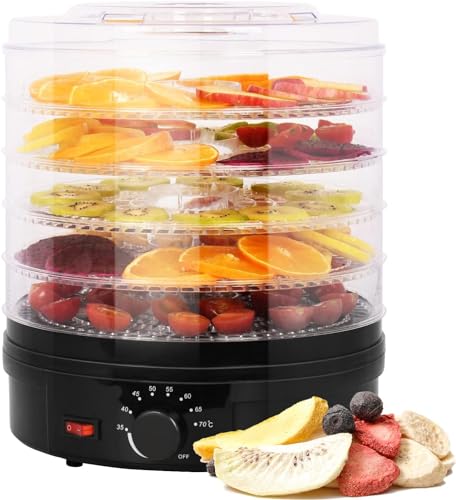
If you are curious about dehydrating but not ready to commit real money, the Cobuy five-layer is the cheapest sensible way to find out whether it suits you. It is as simple as the category gets: five removable, stackable transparent trays, a single operating button and a temperature control that tops out at 70 degrees, which covers fruit, vegetables, herbs, flowers and dog treats comfortably. The trays are dishwasher friendly and lift off for cleaning, and the clear plastic means you can watch the drying progress through the sides. There is no timer, no digital display and no stainless steel here, and with a single button the temperature control is basic. Amazon AU buyers seem happy with it, though, giving it 4.8 stars, albeit from a small pool of 28 reviews. For a student flat, a caravan or a first go at apple chips and fruit leather, it is hard to argue with at this price, and if you find yourself hooked, the box-style units higher up the list are the logical upgrade.
Performance
7.4
Capacity
7.4
Ease of Use
6.3
Build
6.6
Owners
8.6
Owners is the 4.8★ Amazon AU rating from 28 reviews, weighted toward the category average when there are few. Fewer than two published reviews of this exact model, so the owner rating carries that weight too. Tick marks show the category average.
How we scored it
Each measure is marked against the category's rubric, where 10 is the best you can buy, 8 is strong, 6 is basic but sound and 4 falls short. The bars show that mark on the Top7 scale (a 6 reads as 7.0, an 8 as 8.5); the notes quote the rubric mark.
Performance 7.4 (rubric 6.5): Rule: stackable trays score 6, plus 0.5 for heat control to 70C; no timer.
Capacity 7.4 (rubric 6.5): Rule: five trays score 7, less 0.5 for compact stackable trays.
Ease of Use 6.3 (rubric 5): Single button and no timer or display; dishwasher-friendly transparent trays.
Build 6.6 (rubric 5.5): Plastic trays and a lightweight body; 4.8 stars from 28 ratings.
Pros
+ The cheapest dehydrator in this guide by a wide margin
+ Five stackable, dishwasher-friendly transparent trays
+ Single-button operation with heat control up to 70 degrees
+ 4.8-star rating from early buyers
Cons
− No timer or digital display
− Plastic trays and a lightweight body
− Only 28 reviews so far
5 TraysStackableOne-ButtonDishwasher-Friendly TraysUp to 70C
The Biltong King is the specialist on this list. It is not a tray dehydrator at all - it is a stainless-steel biltong box imported from South Africa, designed so strips of beef hang from the top and dry in moving air the traditional way. A built-in 240V fan runs continuous airflow through the cabinet to speed the cure along, and a light fitting sits in the base to drive moisture out; Mellerware recommends a 28W halogen candle bulb, which is not included in the box, and neither is a biltong cutter. That is the trade-off with this style of maker: there is no thermostat and no timer, because a biltong box works by airflow and gentle warmth rather than a set drying temperature. What you get instead is the right shape for the job, a removable base plate that makes the drip clean-up genuinely quick, and an assembly that goes together in minutes. Amazon AU buyers rate it 4.3 stars across 82 reviews. If you want fruit leather and apple chips, buy one of the tray units above. If biltong and droewors are the whole point, this is the pick.
Performance
6.3
Capacity
7.0
Ease of Use
6.3
Build
7.8
Owners
7.7
Owners is the 4.3★ Amazon AU rating from 84 reviews, weighted toward the category average when there are few. Fewer than two published reviews of this exact model, so the owner rating carries that weight too. Tick marks show the category average.
How we scored it
Each measure is marked against the category's rubric, where 10 is the best you can buy, 8 is strong, 6 is basic but sound and 4 falls short. The bars show that mark on the Top7 scale (a 6 reads as 7.0, an 8 as 8.5); the notes quote the rubric mark.
Performance 6.3 (rubric 5): Rule: unheated airflow box (240 V fan plus a bulb that is not included), no thermostat or timer.
Capacity 7.0 (rubric 6): Provisional: no rated meat load on the card; a hanging biltong box scores 6 under the rule.
Ease of Use 6.3 (rubric 5): No timer or thermostat, bulb and cutter not included; assembles in minutes with a removable base plate for cleaning.
Build 7.8 (rubric 7): Stainless steel box with a removable base plate, lightweight; 4.3 stars from 83 ratings.
Pros
+ Purpose-built biltong box shape - meat hangs and dries in moving air
+ Built-in 240V fan gives continuous airflow through the cabinet
+ Stainless steel with a removable base plate for fast clean-up
+ Lightweight, assembles in minutes, 4.3 stars from 82 buyers
Cons
− No thermostat and no timer - airflow drying only
− Light bulb and biltong cutter are not included
− Useless for fruit leather, herbs or anything that needs tray space
Biltong BoxHanging Design240V FanStainless SteelRemovable Base
We evaluate food dehydrators on drying performance (wattage, airflow design, temperature range and how evenly they treat every tray), ease of use (controls, timers, viewing doors and how simply the trays clean), build quality (housing and tray materials, door design, safety cut-outs), capacity (tray count, tray size and how much you can dry in a single batch), and overall value for money. We favour models sold by Australian sellers with SAA-certified plugs and local support. All star ratings and review counts are drawn from live Amazon AU customer feedback.
Scored on Performance 40%, Capacity 25%, Ease of use 20%, Build quality 15%, plus owner ratings and critic reviews
Five or six trays covers a couple or a small family preserving the odd batch of fruit and herbs. Serious jerky and biltong makers, or anyone drying a whole harvest at once, should look at nine or ten trays. Check the tray dimensions too, because a ten-tray unit with small trays can hold less than a six-tray unit with big ones.
Temperature range
Herbs and delicate greens want low heat around 35 to 40 degrees, fruit and vegetables sit in the middle, and meat for jerky needs to reach 70 degrees or more to be safe. A unit that only goes to 70 degrees is fine for plant foods but marginal for jerky, so if meat is the plan, look for a thermostat that reaches 75 to 90 degrees and starts low enough for herbs.
Timer
Dehydrating takes anywhere from four hours for thin apple slices to a full day for thick jerky, so a timer that runs to at least 24 hours and switches the machine off automatically means you can set it before bed and forget it. Cheaper stackable units often have no timer at all, which is workable but means checking on it yourself.
Horizontal vs vertical airflow
Stackable units push air vertically from a base-mounted fan, so the trays nearest the heater dry faster and you will want to rotate them partway through. Box-style units with a rear-mounted fan blow air horizontally across every shelf, drying each tray evenly with no rotating and no flavour transfer between trays. It is the single biggest difference between budget and mid-range dehydrators.
Noise
A dehydrator runs for many hours at a stretch, often overnight, so the fan matters more than you would expect. Quiet, low-wattage fans on stackable units are barely audible, while big 1000W cabinets move a lot of air and are better suited to a laundry or garage bench than an open-plan kitchen.
Trays, doors and cleaning
Stainless-steel trays last longer, will not stain or warp, and are usually dishwasher-safe, while plastic trays are lighter and cheaper. A glass or transparent door lets you check progress without letting the heat out, and a built-in light is a genuine convenience on tall cabinets. Removable trays and a drip tray make cleanup after sticky fruit far less painful.
A food dehydrator is one of those appliances that quietly changes how you shop and cook. A glut of mangoes from the tree, a bag of supermarket-special bananas, a fridge full of herbs that will not last the week: slice them, load the trays and a few hours later you have snacks and pantry staples that keep for months. And for anyone who grew up on biltong or has a soft spot for beef jerky, making your own at home is cheaper, better and far more satisfying than buying it in a packet.
The market splits into two shapes. Stackable round or rectangular units sit a fan and heater in the base and push warm air up through a tower of trays, which keeps them cheap and compact but means the bottom trays dry faster than the top. Shelf-style box units work more like a small oven, with a rear fan blowing air horizontally across every tray for even drying, a door you can open mid-cycle, and usually stainless-steel trays and a proper digital timer. Then there are the dedicated biltong boxes, which are really tall cabinets with hanging rods as well as trays.
We have compared the top-rated dehydrators on Amazon Australia across all three styles, from a one-button five-tray stacker for someone just getting started to a 1000W ten-tray stainless cabinet for serious jerky batches. Whether you want to preserve the veggie patch, dry herbs and flowers or keep a household in homemade biltong, there is a pick here to suit your bench space and budget.
Handy calculators
Free, in Australian units, and built for a phone on the bench.
What is the difference between a stackable dehydrator and a box-style one?+
A stackable dehydrator has the fan and heater in the base and pushes warm air vertically up through a tower of trays, which keeps it cheap and compact but means the lower trays dry faster and you will usually rotate them partway through. A box-style unit has a rear-mounted fan that blows air horizontally across every shelf, so each tray dries evenly and you can open the door to check progress mid-cycle. Box units cost more, take up more bench space and are usually fitted with stainless-steel trays and a proper digital timer.
What temperature do I need for jerky and biltong?+
Meat needs more heat than fruit or herbs to be safe. Most jerky guidance calls for drying at around 70 degrees or higher, so a dehydrator whose thermostat tops out at 70 degrees is workable but leaves no margin. Units that reach 75 to 90 degrees give you more flexibility, while a dedicated biltong box that can also start as low as 20 degrees suits the slower, cooler traditional cure. Always follow a tested recipe and dry meat until it is fully firm and leathery.
How long does dehydrating take?+
It depends on the food, how thickly it is sliced and the humidity in your kitchen. Thin apple rings or herbs can be done in four to six hours, tomatoes and thicker fruit take eight to twelve, and jerky or biltong can run overnight or longer. That is why a timer that reaches 24 or 48 hours and switches the unit off automatically is so useful, and why a lower-wattage machine is not a problem if you are happy to leave it running.
Are food dehydrators noisy or expensive to run?+
The fan is the only moving part, so most dehydrators are no louder than a small desk fan, though big 1000W cabinets move a lot more air and are better placed away from the living area if they run overnight. Running costs are modest: a stackable unit draws around 250 watts and even a large cabinet around 1000 watts, and because they run at low temperature for hours rather than blasting like an oven, a full batch typically costs less than a couple of dollars in electricity.
Should I choose stainless-steel or plastic trays?+
Plastic trays keep the price down and are fine for fruit, vegetables and herbs, especially if they are BPA-free and dishwasher-friendly. Stainless-steel trays cost more but will not stain from beetroot or berries, will not absorb the smell of jerky marinades, and are far more durable over years of use. If meat is a big part of your plan, or you expect to use the machine regularly, stainless trays are worth the extra.