Cake Tin Converter
Cakes scale by area, not by diameter — which is why a 23 cm tin needs a third more batter than a 20 cm one rather than the 15 per cent the numbers suggest. Pick the tin the recipe wants and the tin you own.
Australian unitsFree, no sign-upReviewed 10 September 2026
What do you want to do?
To fill the tin you own
Multiply everything by 1.32×
A 23 cm round holds +32% compared with a 20 cm round. Scale every ingredient by 1.32× and bake for roughly the time the recipe says.
Recipe tin
314 cm²
20 cm round
Your tin
415 cm²
23 cm round
Scale by
1.32×
+32%
Batter depth
−24%
shallower
Do the awkward ingredients here. Flour scales cleanly; eggs do not.
Flour becomes
298 g
Eggs become
4
Raising agents are the exception: scale baking powder and bicarb by a little less than the full factor when you are more than doubling a recipe, or the crumb comes out coarse and the cake sinks.
Every common tin against a 20 cm round
| Tin | Imperial | Area | vs 20 cm round | Scale the recipe by |
|---|---|---|---|---|
| 15 cm round | 6 inch | 177 cm² | -44% | 0.56× |
| 18 cm round | 7 inch | 254 cm² | -19% | 0.81× |
| 20 cm round | 8 inch | 314 cm² | no change | 1× |
| 22 cm round | 8½ inch | 380 cm² | +21% | 1.21× |
| 23 cm round | 9 inch | 415 cm² | +32% | 1.32× |
| 25 cm round | 10 inch | 491 cm² | +56% | 1.56× |
| 28 cm round | 11 inch | 616 cm² | +96% | 1.96× |
| 30 cm round | 12 inch | 707 cm² | +125% | 2.25× |
| 15 cm square | 6 inch | 225 cm² | -28% | 0.72× |
| 18 cm square | 7 inch | 324 cm² | +3% | 1.03× |
| 20 cm square | 8 inch | 400 cm² | +27% | 1.27× |
| 23 cm square | 9 inch | 529 cm² | +68% | 1.68× |
| 25 cm square | 10 inch | 625 cm² | +99% | 1.99× |
| 30 × 20 cm slice | 12 × 8 inch | 600 cm² | +91% | 1.91× |
| 28 × 18 cm slice | 11 × 7 inch | 504 cm² | +60% | 1.6× |
| 33 × 23 cm | 13 × 9 inch | 759 cm² | +142% | 2.42× |
| 25 × 30 cm roasting | 10 × 12 inch | 750 cm² | +139% | 2.39× |
| 21 × 11 cm loaf | 8 × 4 inch | 231 cm² | -26% | 0.74× |
| 23 × 13 cm loaf | 9 × 5 inch | 299 cm² | -5% | 0.95× |
| 26 × 13 cm long loaf | 10 × 5 inch | 338 cm² | +8% | 1.08× |
| 22 cm ring / bundt | 8½ inch | 312 cm² | -1% | 0.99× |
| 24 cm ring / bundt | 9½ inch | 371 cm² | +18% | 1.18× |
Tins you can swap without doing anything
| This tin | Swaps for | What to watch |
|---|---|---|
| 20 cm round | 18 cm square | Within 3 per cent. The classic straight swap. |
| 23 cm round | 20 cm square | Within 2 per cent. |
| 25 cm round | 23 cm square | Within 1 per cent. |
| 20 cm round | 21 × 11 cm loaf | The loaf holds about 25 per cent less — expect a deeper bake and add 10 minutes. |
| 23 cm round | 30 × 20 cm slice | The slice tin is about 45 per cent bigger. Scale up, or accept a thin slab. |
| 22 cm ring | 20 cm round | Close, but the funnel cooks the centre faster — check 10 minutes early. |
Why area and not diameter
The instinct is to compare the numbers printed on the tins, and it is consistently wrong. A 23 cm tin is 15 per cent wider than a 20 cm tin, but it is 32 per cent bigger across the base, because area goes up with the square of the radius. Pour a 20 cm recipe into it and you get a cake two-thirds the depth you expected, done ten minutes early, with a dry edge and not enough middle.
Depth is what actually governs baking. Heat has to travel from the tin wall and the oven air into the centre of the batter, and the distance it has to cover is the depth, not the width. That is why a shallower cake in a wider tin bakes faster at the same temperature, and why a deep loaf needs a lower oven for longer.
The two questions this answers
Scale the recipe. You want the same cake, just in the tin you own. Multiply everything by the area ratio. This is the right answer for a birthday cake that has to be a particular size, and it is what the calculator gives you by default.
Use the batter as it is. You cannot be bothered scaling, or you have no more eggs. Pour it in and adjust the time. Perfectly reasonable for a family cake, as long as you know which direction the time moves — shallower is faster, deeper is slower, and deeper also wants ten degrees off the oven.
Australian tins, American recipes
Australian tins are sold in centimetres and Australian recipes are written for a 20 cm round. American recipes are written in inches for a 9 inch round — 23 cm — or a 9 × 13 inch sheet, which is roughly 33 × 23 cm and has no standard Australian equivalent at all. Our nearest common tin is the 30 × 20 cm lamington tin, about 20 per cent smaller.
British recipes use centimetres like ours but often specify a deep tin, meaning 7 to 8 cm rather than the 4 to 5 cm of a standard Australian sandwich tin. If a fruit cake recipe calls for a deep 20 cm tin and you use a sandwich tin, the batter will go over the side long before it sets. That is a capacity problem rather than an area one, and the fix is to bake the surplus separately.
Scaling the awkward ingredients
Flour, sugar, butter and liquid scale cleanly — multiply and weigh. If you are working from a recipe in cups, convert it to grams with the cups to grams converter first, because scaling 1.32 cups of flour is not a thing you can measure and 297 g is.
- Eggs come in whole units. Round to the nearest one, or beat an egg and use half by weight. A large Australian egg is about 50 g out of the shell.
- Raising agents scale slightly less than proportionally once you go past about double. Multiply baking powder and bicarb by roughly 0.9 of the factor for large scale-ups, or the crumb goes coarse and the cake domes and sinks.
- Salt, spices and vanilla can be scaled straight, but taste as you go on a big multiplier — they can get assertive faster than the rest of the recipe does.
- Baking time stays close to the original when you scale to keep the same depth. It is the depth that changes the time, not the total quantity.
Filling and testing
Fill a butter cake tin about two-thirds, and a whisked sponge or anything heavily raised no more than half. Level the top before it goes in — a scaled recipe often makes just enough extra to matter. Bake in the centre of the oven, and if you are using a fan-forced setting, remember the 20°C rule: a recipe written at 180°C wants 160°C with the fan on, and a sponge would rather have the fan off altogether.
Test with a skewer in the centre, not halfway out. A deep cake in a small tin can read done at the edge and be raw in the middle for another fifteen minutes. If the top is browning too fast, a loose sheet of foil buys you that time without stopping the cook. A stand mixer makes the scaled-up batches easier; the maths is the same either way.
Cake tins — Frequently Asked Questions
How do I convert a cake recipe to a different tin size?+
Work in area, not diameter. Divide the area of the tin you own by the area of the tin the recipe calls for, and multiply every ingredient by that number. Going from a 20 cm round to a 23 cm round is a factor of 1.32 — about a third more batter — even though the diameter has only gone up 15 per cent.
Can I use a 23 cm tin instead of a 20 cm tin?+
Yes, but the cake will be about a quarter shallower and will bake faster, so start checking around 10 minutes early. If you want the same depth of cake, scale the recipe by 1.32. This particular swap is the most common one in Australian kitchens because American recipes are written for 9 inch (23 cm) tins and Australian ones for 20 cm.
What size square tin equals a 20 cm round?+
An 18 cm square, which is within about 3 per cent. As a rule of thumb a square tin holds the same as a round tin roughly 2 cm larger, because the corners add area the circle does not have. A 20 cm square is closer to a 23 cm round.
Do I change the oven temperature as well?+
Only when the depth changes a lot. If the batter ends up noticeably deeper — going from a wide tin to a smaller one — drop the oven by 10°C so the outside does not overbake while the centre catches up, and cover the top with foil once it is golden. A shallower cake bakes at the same temperature, just faster.
How do I scale the eggs?+
Round to the nearest whole egg where you can, and beat one egg and use half when the maths lands near a half. For scaling factors between about 1.2 and 1.5 on a three-egg cake, using four eggs and adding a tablespoon of extra flour usually works better than trying to measure 3.9 eggs.
Does the same maths work for loaf tins?+
Yes — a loaf tin is a rectangle, so its area is simply length by width. A standard Australian 21 × 11 cm loaf tin holds about 25 per cent less than a 20 cm round, which is why loaf cakes made from a round-tin recipe overflow. Loaf tins are also deeper, so they need longer at a lower temperature.
How full should I fill a cake tin?+
Two-thirds for a creamed or butter cake, and no more than half for anything with a lot of raising agent or a whisked sponge. If your scaled quantity would overfill the tin, bake the excess as a few cupcakes rather than risking it over the side.
What is a 9 x 13 inch tin in centimetres?+
About 33 × 23 cm. It is the standard American sheet-cake tin and has no exact Australian equivalent — a 30 × 20 cm lamington tin is the nearest common size and holds around 20 per cent less, so scale the recipe down by about 0.8.
More kitchen calculators
Oven Temperature Converter →
Fan-forced to conventional, Fahrenheit to Celsius and gas marks, the way Australian recipes actually write them.
Cups to Grams Converter →
Australian 250 ml cups and 20 ml tablespoons to grams for 60+ ingredients, plus grams back to cups.
Air Fryer Conversion Calculator →
Turn any oven recipe into an air fryer time and temperature in Celsius, with a chart of Aussie freezer staples.
Meat Temperature Guide →
When to take steak, roasts, chicken, pork and fish off the heat, in Celsius, with the Australian food-safety minimums alongside.
Roast Timer →
Cooking time by weight for lamb, beef, pork with crackling, chicken, turkey and glazed ham, plus a serve-time plan that works backwards from lunch.
Appliance Running Cost Calculator →
What the kettle, the air fryer, the oven and the slow cooker actually cost to run, at your own cents per kilowatt-hour.
Slow Cooker Conversion Calculator →
Move a recipe between the oven, the stovetop, a slow cooker and a pressure cooker — including what to do about the liquid.
Rice to Water Ratio Calculator →
Water, time and yield for nine kinds of rice by saucepan, rice cooker, pressure cooker or microwave — and the 180 ml cup that ruins it.
Coffee to Water Ratio Calculator →
Grams of coffee to millilitres of water for plunger, pour over, AeroPress, moka, cold brew and espresso, with the grind and the time.
Food Storage Chart →
How long 50 foods last in the fridge, the freezer and a vacuum bag, with the Australian food-safety rules that override every number.
Useful? Send it to whoever does the baking.
Scaling a recipe needs scales
Multiplying by 1.32 is only useful if you can weigh the result. These are the seven kitchen scales we rank, from a slimline 5 kg to a bench model with a bowl.

#1 OXO Good Grips 5kg Food Scale with Pull-Out Display
★ 4.7 (2,657 reviews) · A$89.93

#2 Soehnle Page Profi 300 20kg Digital Kitchen Scale
★ 4.5 (12,240 reviews) · A$68.68
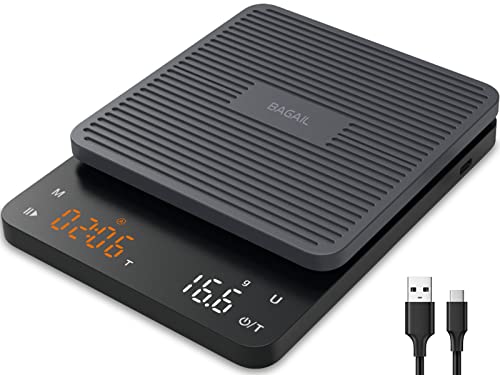
#3 Bagail Basics Coffee Scale with Timer 0.1g 3kg
★ 4.4 (3,225 reviews) · A$39.99
Our rankings
Weekly kitchen deals, in your inbox
We check prices on every appliance we cover daily. Once a week we send the biggest genuine price drops we spot - the ones worth your bench space.
- One email a week, max
- No spam, ever
- Unsubscribe in one click