As an Amazon Associate, top7kitchen.au earns from qualifying purchases. Product prices and availability are accurate as of the date/time indicated and are subject to change. Any price and availability information displayed on amazon.com.au at the time of purchase will apply.
Rankings re-checked weekly · Last re-checked 16 October 2026
·Prices updated daily·AI-assisted, run by Jaco Olwagen
3 quick taps — we'll match you to a pick using the same scores we rank with.
The picks, in order
7 picks
Number one at the top, number 7 at the bottom. The tier label on each card says which price bracket it sits in.
★Editor's Choice
1
SHARPAL
Sharpal 162N Double-Sided Diamond Sharpening Stone
Diamond Stone325/1200 Grit8 x 3 Inch
Premium
Rank #1
Sharpal 162N Double-Sided Diamond Sharpening Stone
Our Verdict
A large 8 by 3 inch dual-grit diamond stone, 325 coarse and 1200 extra fine, with a storage case, non-slip base and a 4-angle guide.
Why it's number one: Ties for the best edge quality with 325 and 1200-grit diamond faces and a four-angle guide, and leads on build with a steel-backed plate; no critic review found; 4.8-star Amazon rating from 11,284 owners, the highest here.
For anyone who wants the finest edge a home sharpener can produce, a stone beats every pull-through in this guide, and the Sharpal 162N is the highest-rated product here at 4.8 stars from 11,227 reviews. It's a generous 8 by 3 inch plate with monocrystalline diamonds electroplated onto a thick steel base, coarse 325 grit on one side to set a new edge quickly and extra fine 1200 grit on the other to hone it. Because it's diamond rather than a traditional water or oil stone, you sharpen dry, it stays flat instead of dishing over time, and it will handle very hard steels, ceramic and carbide that would glaze a conventional stone. The box doubles as a non-slip base, and a built-in angle guide with 14, 17, 20 and 25-degree settings takes much of the guesswork out of holding a consistent bevel. It's sold by Sharpal's Australian arm with a 3-year commitment on after-sales service. You'll need some practice, but it's the one sharpener you'll never need to replace.
Performance
9.3
Edge Quality
9.3
Ease of Use
6.3
Build
9.3
Owners
9.3
Owners is the 4.8★ Amazon AU rating from 11,323 reviews, weighted toward the category average when there are few. Fewer than two published reviews of this exact model, so the owner rating carries that weight too. Tick marks show the category average.
How we scored it
Each measure is marked against the category's rubric, where 10 is the best you can buy, 8 is strong, 6 is basic but sound and 4 falls short. The bars show that mark on the Top7 scale (a 6 reads as 7.0, an 8 as 8.5); the notes quote the rubric mark.
Performance 9.3 (rubric 9): 325-grit coarse diamond side rebuilds an edge in minutes and 1200-grit extra fine hones it, on a plate that stays flat; no serrated capability and only two stages.
Edge Quality 9.3 (rubric 9): 1200-grit diamond finish with the box's angle guide (8) plus 1 for four settings at 14, 17, 20 and 25 degrees; results still depend on freehand consistency.
Ease of Use 6.3 (rubric 5): Freehand stone that needs a flat bench and both hands, with the box as a non-slip base and an angle guide; sharpens dry, but the card says it takes practice.
Build 9.3 (rubric 9): Three-year commitment (8) plus 0.5 for electroplated monocrystalline diamonds and 0.5 for the 0.35 in steel base with rubber pad; 4.8 stars from 11,238 owners.
Pros
+ Highest-rated pick in this guide at 4.8 stars from 11,227 reviews
+ Dual 325 and 1200 grit diamond surfaces cover repair and honing
+ Sharpens dry, stays flat and handles very hard steels and ceramic
+ Storage box doubles as a non-slip base with a 4-angle guide
Cons
− Freehand stone sharpening takes practice, even with the angle guide
− The most expensive pick in this guide
Diamond Stone325/1200 Grit8 x 3 InchAngle GuideSharpens Dry3,800+ Reviews
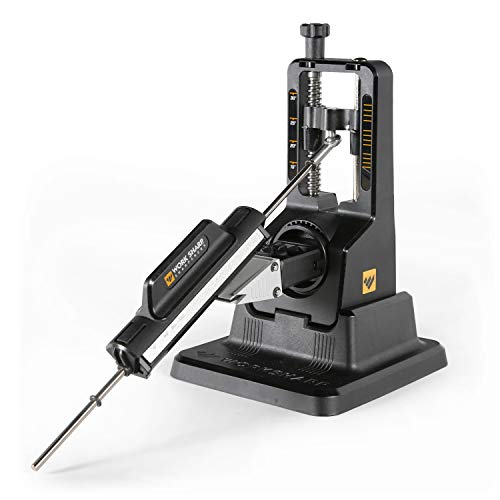
A clamp-and-guide sharpening system that holds any angle from 15 to 30 degrees in 1-degree steps and works through 320 and 600-grit diamond plates to a fine ceramic hone.
The Work Sharp Precision Adjust is the sharpener for people who want stone-quality results without learning to hold an angle freehand. The knife sits in a magnetic, removable V-clamp that takes blades up to 6mm thick, and the sharpening rod swings on a guide you set anywhere from 15 to 30 degrees in 1-degree steps, so a thin Japanese gyuto and a heavy German chef's knife each get their own bevel rather than being forced through one fixed slot. The rod carries three abrasives: a 320-grit diamond plate to rebuild a properly blunt edge, a 600-grit diamond plate to refine it, and a fine ceramic stone to finish, and all three can be used wet or dry. Because you flip the clamp and count your strokes, both sides of the bevel end up even. It is manual, so it is slower than an electric pull-through and needs a clear bench and both hands, and this listing is sold by a third-party seller with free delivery that takes around ten days to Sydney. With 1,049 reviews at 4.4 stars, it is the most controlled way here to put a precise edge on a mixed knife block.
Performance
9.3
Edge Quality
9.3
Ease of Use
7.4
Build
8.9
Owners
7.8
Owners is the 4.4★ Amazon AU rating from 1,054 reviews, weighted toward the category average when there are few. Fewer than two published reviews of this exact model, so the owner rating carries that weight too. Tick marks show the category average.
How we scored it
Each measure is marked against the category's rubric, where 10 is the best you can buy, 8 is strong, 6 is basic but sound and 4 falls short. The bars show that mark on the Top7 scale (a 6 reads as 7.0, an 8 as 8.5); the notes quote the rubric mark.
Performance 9.3 (rubric 9): A 320-grit diamond plate to rebuild a blunt edge, then a 600-grit diamond plate and a fine ceramic stone; the listing makes no serrated-blade claim.
Edge Quality 9.3 (rubric 9): A fine ceramic finishing stone with a guided angle (8) plus 1 for an angle guide from 15 to 30 degrees in 1-degree steps; each side is ground in turn, not both at once.
Ease of Use 7.4 (rubric 6.5): The clamp and angle guide remove the technique of freehand sharpening, but it needs a flat bench, both hands and a set number of strokes per side.
Build 8.9 (rubric 8.5): Provisional: Work Sharp's published 3-year limited warranty (8) plus 0.5 for diamond plates; the housing is plastic with a metal clamp, and this listing comes from a third-party seller.
Pros
+ Angle guide adjusts from 15 to 30 degrees in 1-degree steps for Western and Japanese knives
+ 320 and 600-grit diamond plates plus a fine ceramic stone, usable wet or dry
+ Magnetic V-clamp holds blades up to 6mm thick and keeps the bevel even on both sides
+ 4.4-star rating from 1,049 Amazon AU reviews
Cons
− Manual and slower than an electric sharpener, and it needs a bench and both hands
− Sold by a third-party seller with delivery of around ten days to Sydney
Rolling sharpeners have taken off because they combine the precision of a guided system with the simplicity of a pull-through, and the VEUR is the Australian-owned take on the format. The knife sits against a magnetic angle base with two settings, 20 degrees for standard kitchen, outdoor and pocket knives and 15 degrees for Damascus, santoku and other Asian-style blades, and you simply roll the disc along the edge. Three swappable discs take you through the whole process: 400 grit diamond for coarse sharpening, 1000 grit diamond for honing and a 3000 grit ceramic for polishing, all used dry so there's no mess. The hardwood body looks the part on a bench and the roller is close to silent. It's a newer product with 188 reviews so far, but they average a strong 4.5 stars, and the Australian-based team behind it is a plus for support. If you have a mix of Western and Japanese knives and want a consistent angle on both without learning a stone, this is the sharpener to get.
Performance
8.9
Edge Quality
9.3
Ease of Use
7.4
Build
7.8
Owners
8.4
Owners is the 4.6★ Amazon AU rating from 193 reviews, weighted toward the category average when there are few. Fewer than two published reviews of this exact model, so the owner rating carries that weight too. Tick marks show the category average.
How we scored it
Each measure is marked against the category's rubric, where 10 is the best you can buy, 8 is strong, 6 is basic but sound and 4 falls short. The bars show that mark on the Top7 scale (a 6 reads as 7.0, an 8 as 8.5); the notes quote the rubric mark.
Performance 8.9 (rubric 8.5): 400-grit diamond coarse, 1000-grit diamond honing and 3000-grit ceramic polishing discs; no serrated capability is listed and 400 grit is finer than a repair stage.
Edge Quality 9.3 (rubric 9): 3000-grit ceramic polishing stage with a magnetic angle base (8) plus 1 for both 15 and 20-degree settings.
Ease of Use 7.4 (rubric 6.5): Needs a flat bench and both hands per the card, but sharpens dry with an easy disc swap and a roller VEUR calls whisper quiet.
Build 7.8 (rubric 7): Provisional: no warranty term published (6) plus 0.5 for diamond discs and 0.5 for the hardwood body; 4.5 stars from 188 owners.
Pros
+ Magnetic base with both 15 and 20-degree settings suits Western and Asian knives
+ Three-disc progression from 400 grit diamond through to 3000 grit ceramic
+ Quiet, dry sharpening with an easy disc swap
+ Australian owned and rated 4.5 stars from 188 reviews
Cons
− Needs a flat bench and both hands, so it's less grab-and-go than a pull-through
If you own Global knives, or any Japanese-style blade ground to a fine 15 degrees, this is the sharpener made for them. The G-91/SB uses a pair of ceramic wheels, coarse and fine, that you wet with water before drawing the blade through, and it's designed specifically to sharpen knives at a 15-degree cutting angle rather than the 20 degrees most Western pull-throughs assume. The ergonomic handle keeps your hand well clear of the edge and a rubber base holds it steady on the bench, which makes it about as safe and simple as knife sharpening gets. Replacement ceramic wheels are available, so it won't become landfill when the abrasive eventually wears. It's hand wash only. Amazon AU buyers rate it 4.6 stars across 1,212 reviews, and it ships from Amazon AU, which makes it our value pick for anyone with a thin Asian-style blade in the block.
Performance
8.1
Edge Quality
8.5
Ease of Use
7.4
Build
7.8
Owners
8.5
Owners is the 4.6★ Amazon AU rating from 1,215 reviews, weighted toward the category average when there are few. Fewer than two published reviews of this exact model, so the owner rating carries that weight too. Tick marks show the category average.
How we scored it
Each measure is marked against the category's rubric, where 10 is the best you can buy, 8 is strong, 6 is basic but sound and 4 falls short. The bars show that mark on the Top7 scale (a 6 reads as 7.0, an 8 as 8.5); the notes quote the rubric mark.
Performance 8.1 (rubric 7.5): Coarse and fine ceramic wheels restore a dull edge on 15-degree blades, but no diamond or motorised coarse stage and no serrated capability.
Edge Quality 8.5 (rubric 8): Fine ceramic finishing wheel at a fixed 15-degree guide (8); only one angle, so it re-profiles 20-degree Western knives per the card.
Ease of Use 7.4 (rubric 6.5): Ergonomic handle keeps fingers clear and a rubber base grips the bench, but the ceramic wheels need wetting before each use and it is hand wash only.
Build 7.8 (rubric 7): Provisional: no warranty term on the card (6) plus 0.5 for replaceable ceramic wheels and 0.5 for the rubber base; made in Japan.
Pros
+ Purpose-built 15-degree angle for Global and other Japanese-style knives
+ Coarse and fine ceramic wheels in a simple, safe pull-through design
+ Rubber base and ergonomic handle keep it stable and fingers clear
+ Replacement wheels available and ships from Amazon AU
Cons
− Fixed 15-degree angle will re-profile Western 20-degree knives
− Hand wash only, and the wheels need wetting before each use
15° Angle2-StageCeramic WheelsReplaceable WheelsShips From AU800+ Reviews
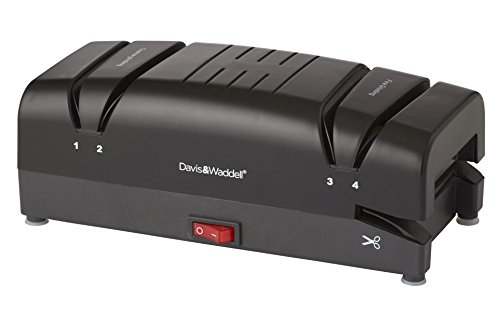
Davis & Waddell is a name Australians know from the kitchenware aisle, and the D1517 Essentials is its straightforward answer to the electric sharpener question. It offers two grind settings, coarse to bring back a properly dull edge and fine to finish it, and the multi-functional design also takes scissors and screwdrivers, which is handy if the kitchen shears have gone blunt too. Non-slip feet keep the unit planted on the bench while you draw the blade through, and a removable drawer catches the metal filings so cleanup is a matter of tipping it into the bin. It ships from Amazon AU, so delivery is quick and returns are painless. At 4.2 stars from 162 reviews it doesn't score quite as highly as the Sharpal, and the listing is light on detail about abrasive type and sharpening angle, so if you own fine Japanese knives we'd steer you towards the Global or the VEUR instead. For a family block of everyday Western knives that just need to cut again, it's a sensible, well-priced electric.
Performance
8.5
Edge Quality
7.8
Ease of Use
9.3
Build
7.8
Owners
7.3
Owners is the 4.2★ Amazon AU rating from 163 reviews, weighted toward the category average when there are few. Fewer than two published reviews of this exact model, so the owner rating carries that weight too. Tick marks show the category average.
How we scored it
Each measure is marked against the category's rubric, where 10 is the best you can buy, 8 is strong, 6 is basic but sound and 4 falls short. The bars show that mark on the Top7 scale (a 6 reads as 7.0, an 8 as 8.5); the notes quote the rubric mark.
Performance 8.5 (rubric 8): Motorised coarse and fine settings that also take scissors and screwdrivers; the card says the listing gives no abrasive type, and no serrated capability.
Edge Quality 7.8 (rubric 7): Provisional: two motorised stages, coarse then fine, at a fixed guide (7); Davis & Waddell publishes no sharpening angle.
Ease of Use 9.3 (rubric 9): Motorised with non-slip feet, a removable filings drawer and no wetting or bench setup; no noise rating is published.
Build 7.8 (rubric 7): 12-month warranty on the listing (7); plastic housing and abrasives of unstated grade; 4.2 stars from 162 owners.
Pros
+ Coarse and fine settings from a familiar Australian kitchenware brand
+ Also sharpens scissors and screwdrivers
+ Non-slip feet and a removable filings drawer for easy cleanup
+ Ships from Amazon AU
Cons
− Listing gives no detail on abrasive type or sharpening angle
− Rated 4.2 stars, lower than the other electric in this guide
ElectricCoarse & FineScissors TooRemovable DrawerShips From AU
Furi's Diamond Fingers has been a fixture in Australian kitchen drawers for years, and it's still the budget sharpener we'd hand to someone who has never sharpened a knife. Instead of wheels or slots, it uses eight diamond-coated Ozitech fingers arranged so that a few pulls set the edge bevel and hone it at the same time, which takes the guesswork out entirely. The outer shell unfolds into a handle with safety guards that keep your hand well away from the blade, then folds flat again so it fits in a drawer or a camping kit. Industrial-grade diamond coating means the abrasive lasts, and Furi backs it with a 25-year guarantee against defects, which is remarkable at this end of the market. It carries a 4.3-star rating from 672 Amazon AU reviews and ships from Amazon AU. It won't rebuild a badly chipped edge the way a coarse stone or electric can, but for keeping everyday knives keen it's hard to beat.
Performance
7.4
Edge Quality
7.0
Ease of Use
8.5
Build
9.6
Owners
7.4
Owners is the 4.3★ Amazon AU rating from 675 reviews, weighted toward the category average when there are few. Fewer than two published reviews of this exact model, so the owner rating carries that weight too. Tick marks show the category average.
How we scored it
Each measure is marked against the category's rubric, where 10 is the best you can buy, 8 is strong, 6 is basic but sound and 4 falls short. The bars show that mark on the Top7 scale (a 6 reads as 7.0, an 8 as 8.5); the notes quote the rubric mark.
Performance 7.4 (rubric 6.5): Eight diamond-coated fingers set the bevel and hone in one pass, but the card says it will not rebuild a badly chipped edge and there is no separate coarse stage.
Edge Quality 7.0 (rubric 6): Provisional: a single diamond stage at a bevel preset by the fingers (6); Furi publishes no angle figure.
Ease of Use 8.5 (rubric 8): Dry pull-through with a folding handle and safety guards that keep fingers clear; compact size means shorter strokes on long knives per the card.
Build 9.6 (rubric 9.5): 25-year guarantee against defects (9) plus 0.5 for industrial-grade diamond coating; the folding shell is stainless steel per the listing.
Pros
+ Eight diamond-coated fingers set the bevel and hone in one motion
+ Folding handle with safety guards keeps fingers clear of the blade
+ 25-year guarantee against defects
+ Compact, ships from Amazon AU and rated 4.3 stars from 672 reviews
Cons
− Single-stage design, so no separate coarse repair stage
− Compact size means shorter strokes on long chef's knives
Diamond CoatedCompactFolding Handle25-Year GuaranteeShips From AU
The Victorinox Dual-Knife Sharpener is the sharpener more Amazon AU buyers have reviewed than any other in this guide, with 18,691 reviews averaging 4.6 stars. It's a pencil-sized tool, 144 mm long and just 40 g, that hides two abrasives: a honing stone at one end for pre-sharpening and a ceramic notch for finishing the edge. It's designed for straight blades, and while it started life as a pocket-knife accessory, it does an honest job of keeping a paring or utility knife keen between proper sharpenings. Build is exactly what you'd expect from Victorinox, and it ships from Amazon AU. Be realistic about what it is, though: this is a touch-up and honing tool, not a machine for rebuilding a chef's knife that hasn't seen a stone in five years. For that you want an electric or a coarse stone. As a cheap, near-indestructible thing to keep in the drawer, the camping box or the caravan, it's a very easy recommendation.
Performance
7.0
Edge Quality
6.6
Ease of Use
6.3
Build
7.0
Owners
8.5
Owners is the 4.6★ Amazon AU rating from 18,846 reviews, weighted toward the category average when there are few. Fewer than two published reviews of this exact model, so the owner rating carries that weight too. Tick marks show the category average.
How we scored it
Each measure is marked against the category's rubric, where 10 is the best you can buy, 8 is strong, 6 is basic but sound and 4 falls short. The bars show that mark on the Top7 scale (a 6 reads as 7.0, an 8 as 8.5); the notes quote the rubric mark.
Performance 7.0 (rubric 6): A honing stone and ceramic notch that keep a keen edge keen; the card says it is a touch-up tool, not a machine for rebuilding a chef's knife, and straight blades only.
Edge Quality 6.6 (rubric 5.5): Ceramic notch finish (6) less 0.5 for no angle guide, so results depend on a steady hand as the card notes.
Ease of Use 6.3 (rubric 5): Pencil-sized 40 g tool used dry, but no guide or base: the angle is held freehand on every stroke.
Build 7.0 (rubric 6): Provisional: no warranty term published on the card or listing (6); ceramic disc rather than diamond and a plastic body; 4.6 stars from 18,732 owners.
Pros
+ Most-reviewed sharpener on Amazon AU with 18,691 reviews at 4.6 stars
+ Honing stone and ceramic notch in a pencil-sized 40 g package
+ Swiss build quality, ships from Amazon AU
Cons
− A honing and touch-up tool, not a full re-profiling sharpener
− Straight blades only, no serrated capability
− No angle guide, so results depend on a steady hand
Pocket SizeCeramic NotchHoning Stone40 gShips From AU18,000+ Reviews
We evaluate knife sharpeners on sharpening performance (how quickly they restore a working edge and whether they can repair chips and heavy wear), ease of use (angle guides, hand safety, speed and cleanup), build quality (abrasive durability, housing materials and warranty), edge quality (how fine and consistent the finished bevel is, and whether the tool suits both 15-degree and 20-degree knives), and overall value for money. We favour models that ship from Amazon Australia or Australian sellers for fast delivery and easy returns. All star ratings and review counts are drawn from live Amazon AU customer feedback.
Scored on Performance 35%, Edge quality 25%, Ease of use 25%, Build quality 15%, plus owner ratings and critic reviews
Electric sharpeners do the work for you with motorised abrasive wheels and are the fastest way to fix a badly dulled blade. Manual pull-through units are cheaper and quieter but need more strokes. Rolling sharpeners and guided-angle systems sit between the two, giving you control over the angle without the learning curve of a freehand stone. Stones deliver the finest edge but take time to master.
Angle guides and bevel angles
Most Western chef's knives are ground to around 20 degrees per side; Japanese-style knives such as santoku, nakiri and gyuto are usually a finer 15 degrees. A sharpener with a fixed angle will re-profile any knife to that angle, so check it matches your knives. Systems with selectable 15 and 20-degree settings, or a stone with an angle guide, cover both.
Abrasive type
Diamond abrasives cut fastest and last longest, which makes them ideal for coarse stages and for hard modern steels. Ceramic is finer and gentler, so it's the usual choice for honing and polishing stages. Carbide slots remove metal quickly but aggressively, so treat them as a repair step rather than a regular touch-up. Multi-stage units combine a coarse abrasive with a fine one for the best of both.
Stages and grit
A single-stage sharpener is fine for routine maintenance, but a 2 or 3-stage design lets you repair a damaged edge on a coarse stage, refine it on a medium and polish it on a fine. On stones and rolling kits, grit numbers tell the same story: lower numbers around 300 to 400 for reshaping, 1000 for everyday sharpening and 3000 and above for a polished finish.
Serrated knife compatibility
Bread knives and steak knives can't go through a standard V-slot without damaging the teeth. If you want to sharpen serrated blades, look for a sharpener that specifically lists serrated compatibility, usually via a fine polishing stage or a tapered diamond rod that works inside each scallop.
Safety, noise and cleanup
Look for a non-slip base or suction feet so the unit stays planted while you pull the blade, and a handle or guard that keeps fingers clear. Electric units can be noisy, so a quieter motor is worth having in an open-plan kitchen, and a removable drawer or filings tray makes cleanup much easier.
A blunt knife is the most dangerous tool in the kitchen, and also the most common. Most of us buy a decent chef's knife, use it daily for a couple of years, then wonder why tomatoes squash instead of slice. The fix isn't a new knife, it's a sharpener, and a good one will bring a tired blade back in a few minutes and keep it there with a quick touch-up every few weeks.
The market splits into a few camps. Pull-through sharpeners, whether manual or electric, hold the blade at a preset angle so you can't get it wrong, and they suit most home cooks. Rolling sharpeners and guided-angle systems give you more control over the bevel, which matters if you own thin Japanese knives ground to 15 degrees rather than the 20 degrees typical of Western blades. Then there are stones, the traditional choice, which take practice but reward it with the keenest edge of all.
We've compared the top-rated knife sharpeners on Amazon Australia across all of those styles, from a pencil-sized Victorinox pocket tool with more than eighteen thousand reviews to a Work Sharp guided-angle system that sets any bevel from 15 to 30 degrees. Whether you want a set-and-forget electric for the family knife block or a diamond stone to do the job properly, there's a pick here to match your knives and your patience.
Compare Top Picks
Can't decide between our top two? See how they stack up head‑to‑head.
Electric or manual knife sharpener, which should I buy?+
An electric sharpener is the fastest and most foolproof option, especially for a blade that has gone properly blunt, because the motor does the work and the slots hold the angle for you. A manual pull-through or rolling sharpener costs less, is quieter and takes up less space, but needs more strokes and a bit more care. If you sharpen a family's worth of knives a few times a year, go electric; if you touch up one or two knives regularly, a good manual will do.
What angle should I sharpen my knives at?+
Most Western chef's knives from European brands are ground to roughly 20 degrees per side, while Japanese-style knives such as santoku and gyuto are typically a finer 15 degrees. A sharpener with a fixed angle will slowly re-profile your knife to that angle, which isn't a disaster but does change how the edge behaves. If you own both styles, choose a sharpener with selectable 15 and 20-degree settings or a stone with an angle guide.
Can I sharpen serrated knives with these sharpeners?+
Only with a sharpener that specifically says so. Pulling a serrated bread knife through a standard V-slot will grind the tips off the teeth. Sharpeners that handle serrations usually do it on a fine polishing stage that touches only the flat side of the blade, or with a tapered rod that fits inside each scallop. Serrated knives hold an edge for years, so most people never need to sharpen them at all.
Diamond, ceramic or stone, which abrasive is best?+
Diamond is the hardest and fastest-cutting abrasive, so it's ideal for coarse work and for the hard steels used in modern knives, and it lasts a very long time. Ceramic is finer and removes less metal, which makes it the natural choice for honing and polishing. A traditional water stone gives the most refined edge in skilled hands but needs soaking, flattening and practice. Many of the best sharpeners combine diamond for the coarse stage with ceramic for the fine one.
How often should I sharpen my kitchen knives?+
For a knife used daily, a full sharpen every few months is usually enough, with a quick hone on a steel or the fine stage of your sharpener every week or two to keep the edge aligned in between. The simplest test is a ripe tomato or a sheet of paper: if the blade squashes rather than slices, it's time. Sharpening removes metal, so don't overdo it, and stick to the fine stage for routine touch-ups.