26 May 2026 · Knife Sets · AI-assisted · published by Jaco Olwagen · How we rank
Forged vs Stamped Kitchen Knives: What the Price Difference Actually Gets You
Forged knives cost 2-4x more than stamped. Here's what that extra money buys you and whether it's worth it for Australian home cooks.
The short answer nobody wants to hear
Forged knives are better. Stamped knives are fine. Whether that gap matters depends entirely on how much you cook and how much you care about the feel of a knife in your hand.
That's the honest truth, and the rest of this post is about understanding exactly where the differences show up - and where they don't - so you can spend your money wisely.
What forged actually means
 Wusthof Classic Knife Set 6-Piece 1120160602A$921.79Check Price
 A forged knife starts as a single piece of steel that gets heated, hammered (or pressed) into shape, then ground, tempered and sharpened through dozens of production steps. The Wusthof Classic 6-piece set, for example, goes through 55 production steps with over 20 quality controls per blade. That's not marketing fluff - it is most of why forged sets sit at the top of the price ladder.
The forging process creates a blade with a consistent grain structure throughout the steel. Think of it like kneading bread dough properly versus just smushing it together. The result is a knife that's heavier, better balanced, and typically holds its edge longer.
Forged options sold in Australia include the Wusthof Classic (German high-carbon steel, full bolster), the Global Takashi range (CROMOVA 18 Japanese steel) and the Mercer Culinary Renaissance, which puts full-tang forged German steel into a set aimed at working kitchens rather than collectors.
What stamped actually means
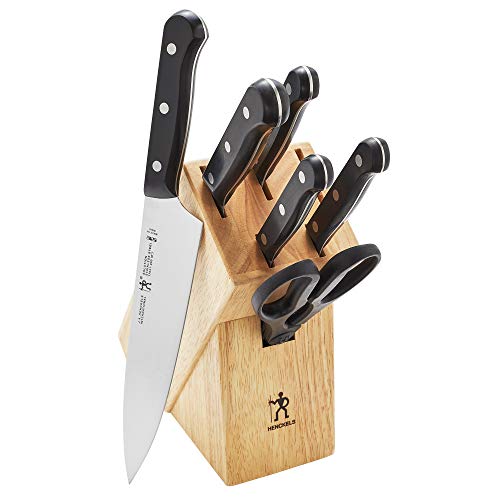 Henckels Solution 7-Piece Knife Block SetA$237.70Check Price
 A stamped knife is cut from a flat sheet of steel - like a cookie cutter punching shapes from dough. The blank gets heat-treated, ground to an edge, and fitted with a handle. Fewer steps, less labour, lower price.
The Henckels Solution set is stamped, and so are most sets you will find at the budget end of the market. Does that make them bad knives? Not remotely. Victorinox, whose kitchen range is stamped, supplies knives to professional culinary schools around the world - their Fibrox Pro handles are grippy even when wet, and the blades use the same high-carbon stainless steel as the rest of their professional line.
Where forged knives genuinely win
- Balance and heft. A forged knife has a bolster (that thick bit where the blade meets the handle) that creates a natural balance point. When you're doing a rocking chop through a pile of herbs, that weight distribution matters. Stamped knives are lighter and more uniform - some cooks prefer this, but most find forged knives feel more controlled.
- Edge retention. The forging process generally produces a denser, more consistent grain in the steel, so a forged blade will go longer between sharpenings than a stamped one at the same price point. How much longer depends on what you're cutting and how you maintain them, but the gap is real and it widens over months rather than days.
- Longevity. Forged blades are typically thicker and more robust. With proper care, a quality forged set lasts decades. Your grandkids could use them. Stamped blades are thinner and can develop flex or warping after years of heavy use.
- The intangible. This sounds wanky, but it's real. Picking up a beautifully forged knife feels different. There's a confidence to it. If you cook every day and genuinely enjoy the process, that feeling has value.
Where stamped knives hold their own
- Sharpness out of the box. Both styles can be ground to a razor edge. A brand new stamped knife is just as sharp as a brand new forged one. The difference only emerges over weeks of use.
- Weight. If you have wrist issues or arthritis, lighter stamped knives cause less fatigue. The Henckels Solution set specifically uses lightweight stamped blades that are easy to handle for extended prep sessions.
- Value per piece. Stamped sets routinely include a block, shears and a honing steel for a fraction of what a forged set costs without any of them. If the budget is tight, the maths is not close.
- Replaceability. If you share a kitchen with someone who chucks knives in the dishwasher (don't do this, by the way), a budget set stings a lot less to replace than a premium one.
The middle ground nobody talks about
Some of the best sets sold here blur the forged-stamped line rather than sitting neatly on one side of it.
The Ninja StaySharp set uses high-carbon German stainless steel blades that are not traditionally forged, but the built-in sharpeners in the block micro-sharpen every knife each time you slot it back in. It is the highest-rated set in our ranking, because it solves the real problem most home cooks have: not maintaining their knives properly.
The Furi Pro Capsule set takes a different approach - Australian-designed, with Japanese X50CrMoV15 stainless steel hardened to 55-57 HRC. That is a harder steel than most German forged options, in a set that costs a fraction of the premium picks. The reverse-wedge handle design is genuinely comfortable too.
How to tell forged from stamped before you buy
Listings rarely say it outright, so it is worth knowing the tells. None of these require handling the knife.
- Look for a bolster. That thick collar of steel between the blade and the handle is the clearest visual sign of a forged blade. Stamped knives usually run straight from blade to handle with no step. Zoom into the product photo at the heel of the knife.
- Read the spine. A forged blade is noticeably thicker at the spine and tapers toward the tip. In a side-on photo, a stamped blade looks like a flat sheet of even thickness, because that is exactly what it is.
- Check for "full tang". Makers advertise it when they have it. A full tang - steel running the whole length of the handle, usually with visible rivets - almost always accompanies forged construction.
- Weigh the wording. "Forged", "drop-forged" and "hot-forged" are used precisely because they cost money to earn. "Precision-cut", "laser-cut" and "taper-ground" are describing a stamped blade in flattering terms.
- Use price as a sanity check. Forging is labour, and labour shows up in the price. A full block set at the cheap end of the market is stamped, whatever the listing implies.
The bottom line
Forged knives are better tools. Full stop. But "better" doesn't always mean "the right choice for you." A sharp stamped knife will outperform a dull forged one every time, and most home cooks aren't maintaining their knives well enough to get the full benefit of that premium steel.
If you're going to invest in forged knives, commit to the maintenance too - honing before each use and professional sharpening once or twice a year. Otherwise, you're paying a premium for potential you'll never unlock.
For which specific set to buy - current Australian prices, what is in each block, and how the forged and stamped options rank against each other - see our best kitchen knife sets in Australia guide, which is kept up to date daily.
Work it out while you cook
Free calculators in Australian units — no sign-up, and they remember where you left off.
- Meat Temperature Guide →When to take steak, roasts, chicken, pork and fish off the heat, in Celsius, with the Australian food-safety minimums alongside.
- Roast Timer →Cooking time by weight for lamb, beef, pork with crackling, chicken, turkey and glazed ham, plus a serve-time plan that works backwards from lunch.
Top Picks — Check Latest Prices


See Our Top 7 Knife Sets for Australia
Hand-picked and ranked by our editors — with honest pros, cons, and Aussie pricing.
Weekly kitchen deals, in your inbox
We check prices on every appliance we cover daily. Once a week we send the biggest genuine price drops we spot - the ones worth your bench space.
- One email a week, max
- No spam, ever
- Unsubscribe in one click